A Contractors Guide to the Concrete Maturity Method
This eBook covers a brief history of Concrete Maturity and what has become known as the Maturity Method, including key benefits of using this method.
INTRODUCTION
Concrete is the most versatile and widely used construction material in the world. One of the very few downsides to using concrete in construction is predicting the time needed to reach design strength so the project can move forward.
WHAT IS THE CONCRETE MATURITY METHOD?
The Concrete Maturity Method is a non-destructive testing method used to estimate the early-age strength development of in-situ concrete. Based on the principle that concrete strength is directly related to its hydration temperature history, the Maturity Method is a simple approach for estimating the compressive strength of concrete, especially at early ages (less than 14 days).
Despite concrete being used for millennia, the understanding and application of concrete Maturity Methods were limited and not widely adopted in construction practices before the 1970s.
Thanks to innovative new technologies — like embedded sensors, data loggers, AI, and analytics platforms — the concrete Maturity Method offers real-time strength data and accurate estimations of strength.
Since contractors, architects, and engineers are always looking for ways to speed up construction to reduce schedules and drive profitability, the modern Concrete Maturity Method is designed for predicting concrete strength — especially when concrete is on the critical path of construction.
The Method offers a predictive model for assessing concrete strength accurately and efficiently. However, despite its proven advantages — including significant time and cost savings as well as safety and sustainability benefits — its adoption faces hurdles due to misconceptions and a lack of understanding among key construction stakeholders.
This guide aims to clarify the principles, applications, and new innovations in the concrete Maturity Method — using concrete sensors and advanced analytics — to deliver cost savings and efficiency gains, and even support sustainability goals.
THE MODERN CONCRETE MATURITY METHOD
- Embedded sensors record temperature and strength in real time
- Accurate estimations are calculated using advanced analytics
- Strike formwork up to 38% sooner.
PRINCIPLES OF CONCRETE MATURITY
Concrete maturity is a measure that provides insight into the progression of concrete curing and strength development, predicated on the concrete’s temperature history over time. This concept hinges on the understanding that concrete’s strength gain is not just a function of time but is significantly influenced by the curing temperature. High temperatures accelerate the chemical reactions in concrete, thus speeding up strength development, whereas low temperatures slow these reactions.
THE SCIENCE BEHIND MATURITY
The maturity of concrete is calculated using specific formulas that integrate the effect of temperature over time. Two primary models are used:
- NURSE-SAUL METHOD: Calculates maturity as a function of time and temperature, considering a baseline temperature below which strength development is negligible.
- ARRHENIUS MODEL: Provides a more sophisticated approach by calculating the ‘equivalent age’ of concrete at a reference temperature, considering the exponential effect of temperature on reaction rates.
Both models require continuous monitoring of concrete temperatures, from which a maturity index can be derived. A maturity index (calculated in Celsius hours) predicts concrete strength based on a pre-established correlation between maturity and strength for the specific concrete mix used.
CONCRETE STRENGTH VERSUS MATURITY
The terms “maturity” and “strength” are not interchangeable, but there is a relationship between maturity and strength of a concrete mix.
The strength of concrete and other related properties are directly proportional to the age and temperature variations of the concrete structure.
THE EVOLUTION OF CONCRETE TESTING: FROM CYLINDERS TO SENSORS
Initially, the construction industry relied on empirical methods to estimate concrete strength, the most common of which is the manual cylinder testing method where contractors would take two sets of samples — known as cylinders — when concrete is poured. The first set is cured under standard curing conditions in a lab, and the second set is left to cure on the job site. At various times, a field-cured sample is sent to a lab for strength testing. This is repeated until the desired strength is reached. This manual testing process has several limitations:
-
TIME DELAYS IN STRENGTH ASSESSMENT
The need to physically transport samples to a laboratory for testing introduces significant delays in obtaining results. This waiting period can hinder project progress, especially when decisions regarding formwork removal or the application of loads depend on concrete achieving specific strength milestones. -
LIMITED DATA POINTS
Cylinder testing provides only intermittent data points based on when the samples are tested. This snapshot approach does not offer continuous insight into the concrete’s strength development, potentially missing critical phases of strength gain or loss. -
INABILITY TO REFLECT ACTUAL CONSTRUCTION CONDITIONS
Lab-cured samples will have different conditions that don’t reflect those on site. Field-cured samples are intended to better reflect the actual curing conditions of the in-situ concrete. However, factors such as exposure to environmental conditions, load application, and variations in formwork can still create discrepancies between the strength of field-cured samples and the actual structure. -
RESOURCE INTENSIVE
The process of casting, curing, transporting, and testing samples is labor-intensive and requires significant resources, including time, manpower, and materials. This can increase project costs and complicate logistics, especially for large-scale or remote projects.
These limitations have prompted the construction industry to seek accurate, efficient, and sustainable methods for assessing concrete strength in the field. The adoption of the Concrete Maturity Method — using embedded sensors, data loggers, and analytics platforms — represents a significant advancement in overcoming these challenges, offering real-time, continuous monitoring of concrete strength development without the drawbacks of manual cylinder testing.
TESTING STANDARDS AND REGIONAL COMPLIANCE
As we explore the Concrete Maturity Method, it’s important to recognize the regulatory
landscape that governs its application. Today, various codes and standards exist for maturity testing, which vary regionally and are subject to regular updates. Adhering to these standards ensures that construction practices are aligned with the latest industry norms and regulatory requirements.
CANADA
- CSA A23.1/A23.2: Concrete Materials and Methods of Concrete Construction/Test Methods and Standard Practice for Concrete.
UNITED STATES
- ASTM C1074: Standard Practice for Estimating Concrete Strength by Maturity Method.
- ASTM C918: Standard Test Method for Measuring Early-Age Compressive Strength and Projecting Later-Age Strength.
- ACI 318- 6.2: Building Code Requirement for Structural Concrete and Commentary.
- ACI 228.1R: In-Place Methods to Estimate Concrete Strength.
- ACI 306R: Guide to Cold Weather Concreting.
-
AASHTO T325: Standard Method of Test for Estimating the Strength of Concrete in Transportation Construction by Maturity Tests.
THE CONCRETE MATURITY METHOD
The Concrete Maturity Method leverages technology from simple thermocouples to IoT, wireless and wired sensors, AI, and analytics technologies to accurately predict the compressive strength of concrete.
The Maturity Method is governed by the basic assumption that a concrete mix design poured on a project has the same compressive strength at its maturity index. In other words, a concrete mix may reach the same compressive strength after 15 hours of curing at 20ºC as when it is cured for 10 hours at 30ºC. That’s because when the concrete cures, it creates heat from cement hydration, which gets trapped inside the concrete. The high temperature helps the concrete cure faster.
The Maturity Method requires pre-calibration of a concrete mix before it can be used to correlate the concrete maturity to its strength.
The aim of performing a maturity calibration is to find the relationship between time, temperature, and strength for each concrete mix design that you intend to use.
PREPARATION FOR THE MATURITY METHOD
Implementing the Maturity Method starts with the calibration process to establish a relationship between maturity and concrete strength for the specific mix design in question.
This involves casting concrete samples under controlled conditions, monitoring their temperature history, and testing their strength at various ages. The results produce a maturity curve that serves as a reference for field applications.
CREATING A MATURITY CALIBRATION CURVE
Calibration is a critical step that involves testing several concrete specimens at different curing times to develop a correlation curve between the concrete’s maturity index and its compressive strength. This curve is unique to each concrete mix and is used to predict the in-situ concrete strength accurately.
THE ROLE OF SENSORS
Sensors play a pivotal role in the Maturity Method of testing, continuously recording the temperature of in-situ concrete.
The choice of sensors (wired vs. wireless), their placement within the concrete structure, and the frequency of data collection are crucial considerations for accurate maturity assessment.
IMPLEMENTING THE MATURITY METHOD IN CONSTRUCTION PROJECTS
The implementation of the Maturity Method of testing in construction projects requires coordination between project managers, engineers, and field technicians. Ensuring that the calibration curve is accurately developed and applied, that sensors are correctly installed and functioning, and that data is continuously monitored and interpreted, are all key to leveraging the full benefits of the Maturity Method for concrete strength estimation.
CYLINDER VS. MATURITY METHOD
TYPES OF MATURITY SENSORS
Maturity sensors may be wired or embedded. The choice will depend on the project’s specific needs, including scale, complexity, and environmental factors.
WIRED SENSORS (NON-EMBEDDED)
Wired sensors are embedded within the concrete, at various depths and locations, depending on the project requirements, with wires extending to a central data logger, ensuring continuous and accurate monitoring of temperature changes crucial for calculating the maturity index.
The primary advantage of wired sensors is their proven reliability and accuracy. They offer continuous, direct monitoring of concrete’s temperature, which is crucial for accurately calculating maturity indexes.
OPERATIONAL CONSIDERATIONS FOR WIRED SENSORS
Despite their benefits, the use of wired sensors requires careful operational planning, especially in large-scale or complex concrete pours. Managing the wires and ensuring their integrity throughout the curing process can present logistical challenges. Some key considerations include:
-
Cable Management
- The physical presence of wires running from the embedded sensors to the data logger necessitates meticulous planning to avoid interference with construction activities and ensure the wires remain protect and connected
-
Post-Curing Cable Treatment
- Trailing cables that emerge from the cured concrete pose their own set of issues. These cables, while necessary during the monitoring phase, eventually need to be cut. The resultant holes must then be sealed with concrete to maintain the integrity of the structure. This step adds an additional layer of operational tasks post-data collection.
Despite these challenges, wired sensors are highly valued for projects where stable, uninterrupted data collection is paramount. They are particularly suited to environments where wireless communication might be unreliable or where the additional precision of a wired connection is required.
WIRELESS SENSORS (EMBEDDED)
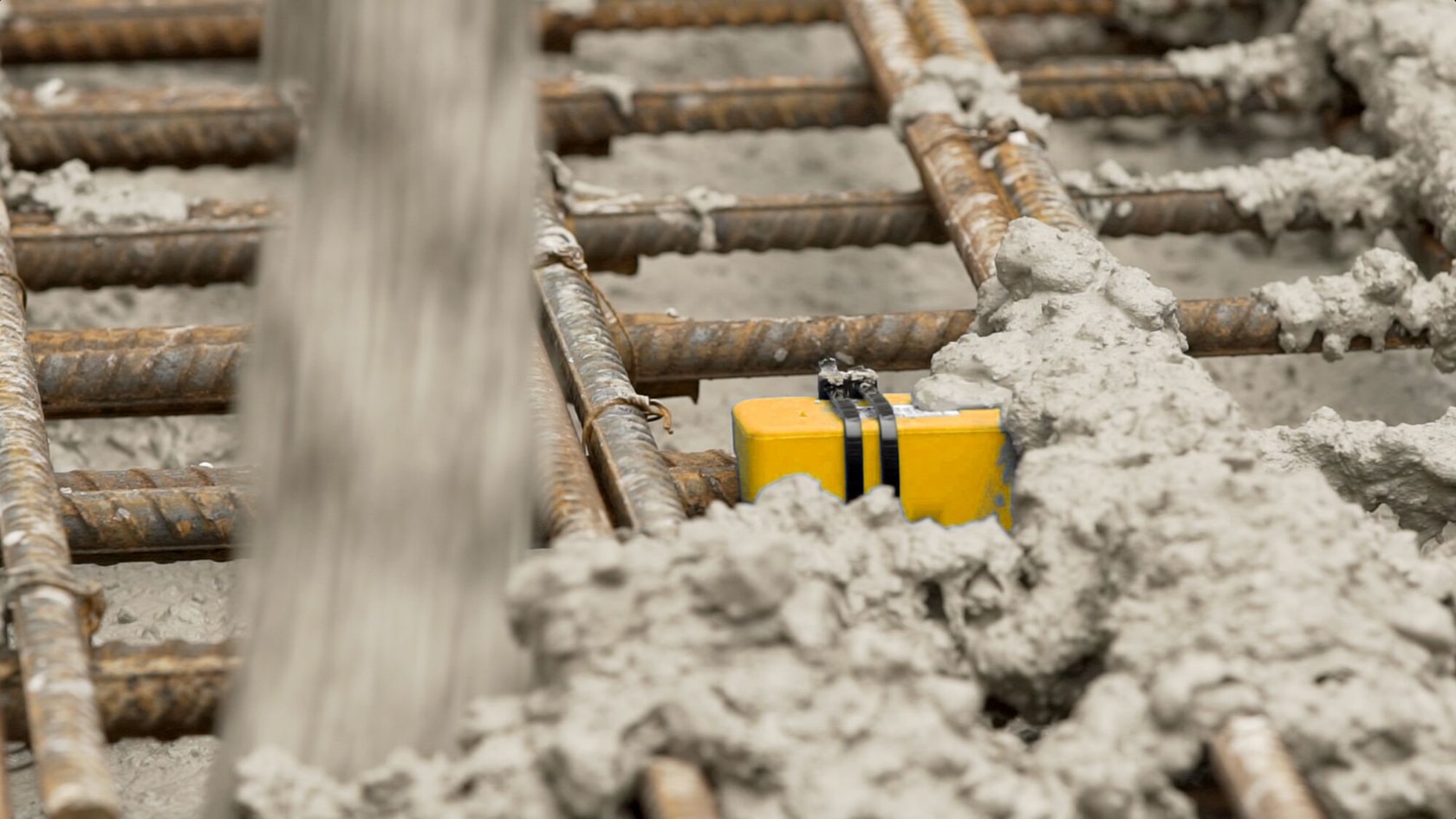
Embedded sensors offer a seamless, non-intrusive way to monitor the curing process from within the concrete itself. These sensors are attached to the rebar before a pour and remain in place throughout the lifespan of the structure. They measure temperature and other relevant data, transmitting this information wirelessly to a receiver or directly to a cloud-based platform.
The advantage of embedded sensors is their ability to provide real-time, comprehensive data without the need for external wires or manual data retrieval. This wireless transmission eliminates many logistical hurdles associated with wired sensors, making the setup quicker and reducing the risk of data loss or damage to physical connections.
Embedded sensors are particularly beneficial for monitoring critical structural elements where understanding internal conditions is essential for assessing overall concrete maturity and strength.
Embedded sensors streamline the process of concrete monitoring, allowing for more dynamic and responsive project management. By delivering accurate, real-time insights directly to stakeholders, these sensors empower teams to make informed decisions faster, optimizing construction schedules and enhancing the safety and durability of the finished structure.
Embedded sensor
THE BUSINESS CASE FOR THE CONCRETE MATURITY METHOD
The transition to the Maturity Method from traditional testing techniques is not just a technical upgrade but a strategic business decision. By harnessing the predictive power of the Maturity Method, contractors can achieve remarkable cost savings, efficiency improvements, and sustainability benefits.
COST SAVINGS
Implementing the Maturity Method of testing helps you move the project forward and strike formwork as soon as possible.
By reducing the need for numerous samples and laboratory tests, project costs are also directly cut. Additionally, the method’s accuracy minimizes the risk of rework due to premature load applications, further saving resources and expenses.
Using the Maturity Method on construction projects has clear economic benefits. Not only can large projects save money—but smaller ones can too.
The Maturity Method can save a lot of time by making essential tasks like removing formwork, post-tensioning, and opening roads to traffic much faster and more efficiently. And in the construction business, saving time means saving money.
Starting to use the Maturity Method does have some upfront costs, like buying and calibrating the maturity sensors. But the real value comes from the money it saves in the long run.
THE FUTURE OF MATURITY TESTING
The landscape of concrete maturity testing is still evolving today. Innovations such as wireless sensor networks, Internet of Things (IoT) connectivity, and cloud computing are making real time data collection and analysis accessible. These technologies facilitate a seamless flow of information, enabling construction teams to make informed decisions swiftly, based on the latest concrete strength data.
THE ROLE OF AI AND MACHINE LEARNING IN PREDICTING CONCRETE STRENGTH
Artificial Intelligence (AI) and machine learning are set to play a pivotal role in the future of concrete maturity testing. These technologies can analyze vast amounts of data collected from sensors embedded in concrete, identifying patterns and correlations that may not be apparent through traditional analysis methods. By learning from historical data, AI models can predict concrete strength with high accuracy, potentially eliminating the need for physical testing.
CONCRETEDNA — POWERING THE NEXT GENERATION OF CONCRETE CONSTRUCTION
ConcreteDNA is a powerful technology that combines some of the most cutting-edge technologies with robust sensors to deliver AI-powered concrete monitoring, data management, and mix selection capabilities. It helps busy contractors make informed decisions quickly, optimize labor and resources, and accelerate project timelines.
Concrete Monitoring Comprises Three Technologies:
ENHANCING SUSTAINABILITY AND EFFICIENCY IN CONSTRUCTION
Advanced Maturity Methods are also expected to contribute significantly to sustainability and efficiency in construction. By providing accurate strength predictions, these methods can help optimize the use of materials and reduce waste.
For example, knowing the exact point at which concrete reaches sufficient strength could minimize the overuse of cement, a major source of embodied carbon emissions in construction.
Additionally, the ability to accurately predict concrete strength in real time allows for more efficient project scheduling and resource allocation. This can lead to shorter construction times, reduced labor costs, and lower overall environmental impact.
The data collected through the Maturity Method can also be used to optimize concrete mix designs.
KEY TAKEAWAYS
- Concrete has been around for millennia, but maturity testing has only evolved in the last 50 years.
- Concrete maturity remains a challenge for contractors today as it is difficult to accurately predict the time needed for concrete to reach sufficient strength to proceed with construction phases.
- Traditional cylinder testing methods have several limitations, including delays in strength assessment, limited data points, and the inability to accurately reflect in-situ concrete conditions.
- The Concrete Maturity Method has emerged as a groundbreaking approach for estimating concrete strength more accurately and efficiently than traditional methods like cylinder testing.
- The Maturity Method employs sensors and advanced analytics for assessing concrete strength in real-time.
- The Method is rapidly evolving with advancements in sensor technology, IoT, AI, and analytics. It offers precise, real-time data on concrete strength, temperature, and environmental conditions.
- Adopting the concrete Maturity Method could lead to cost savings, efficiency gains, and reduced project risks.
- With the move toward sustainable construction practices, the Maturity Method reduces the risk of adopting new technologies to enhance sustainability in construction projects.
- The future of concrete maturity testing promises further innovations with the integration of AI and machine learning for predictive strength analysis, enhancing the sustainability and efficiency of construction practices.
Converge, a DEWALT Product
Learn More about DEWALT Concrete Sensors
DEWALT Concrete Sensors are a line of wireless sensors designed to monitor concrete's temperature during the curing process. These sensors are used in construction projects to ensure that concrete is cured properly, which can help prevent cracking and other problems that can compromise the structure's integrity.